
If you’re shopping for a new vacuum this year, you’re probably wondering about the real difference in the Robot Vacuum vs. Traditional Vacuum debate.
Do you really need a robot vacuum — or is a traditional upright still the better choice?
With smart features like auto-empty docks, LiDAR navigation, and powerful suction ratings now exceeding 8,000 Pa on premium models, robot vacuums in 2026 are more capable than ever.
But when it comes to Robot Vacuum vs. Traditional Vacuum, which one actually delivers better cleaning performance and value?
Let’s break it down clearly so you can decide what fits your home, budget, and cleaning style.
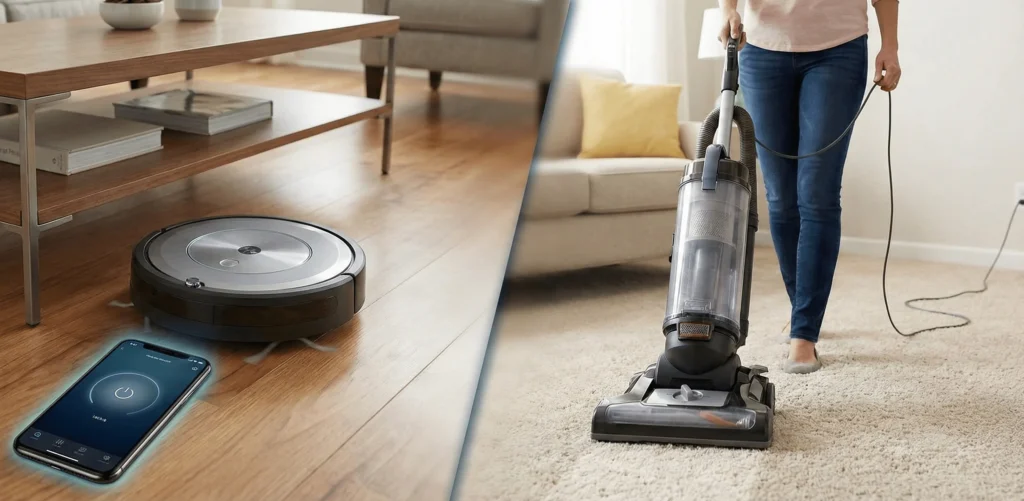
Quick Comparison: Robot Vacuum vs. Traditional Vacuum
| Feature | Robot Vacuum (2026 Models) | Traditional Upright / Canister |
|---|---|---|
| Hands-free cleaning | ✅ Fully automated | ❌ Manual operation |
| Deep carpet cleaning | ⚠️ Good (depends on model) | ✅ Excellent |
| Daily maintenance cleaning | ✅ Excellent | ❌ Requires effort |
| Pet hair pickup | ✅ Very good (premium models) | ✅ Excellent |
| Initial cost | Higher | Lower |
| Long-term effort | Very low | High |
| Smart mapping | ✅ Yes | ❌ No |
| Spot cleaning control | App-controlled | Manual |
1️⃣ Cleaning Power: Which Cleans Better?
Traditional Vacuum
Traditional uprights still win in raw suction power and deep carpet agitation. If you have:
- Thick, high-pile carpet
- Heavy sand or debris
- Large homes cleaned once per week
A powerful upright can still remove embedded dirt better in a single session.
Robot Vacuum (2026 Models)
Modern robot vacuums now feature:
- 6,000–10,000 Pa suction
- Auto carpet boost
- Dual rubber brush rollers
- AI dirt detection
For daily cleaning and maintenance, robot vacuums often keep floors cleaner overall because they run every day — not once a week.
👉 If you want help choosing a high-performance model, see our Complete Robot Vacuum Buying Guide.
2️⃣ Convenience: This Is Where Robot Vacuums Dominate
The biggest difference isn’t power.
It’s effort.
Robot Vacuum Advantages
- Cleans while you’re at work
- Scheduled cleaning
- App control
- Voice assistant support
- Self-empty docks (up to 60 days of debris storage)
You don’t push it. You don’t carry it. You don’t think about it.
Traditional Vacuum Drawbacks
- Requires physical effort
- Takes 20–45 minutes per session
- Easy to procrastinate
- Bulky storage
If convenience is your priority, robot vacuums win by a huge margin.
3️⃣ Cost Comparison (2026)
Upfront Cost
- Traditional vacuum: $100–$400
- Robot vacuum: $300–$1,200
Premium robot vacuums cost more initially.
5-Year Ownership Cost
If you value your time, the automation often justifies the difference. Also consider:
- Replacement bags (upright)
- Filter replacements
- Electricity use (minimal difference)
Robot vacuums are an investment in convenience rather than raw cleaning power.
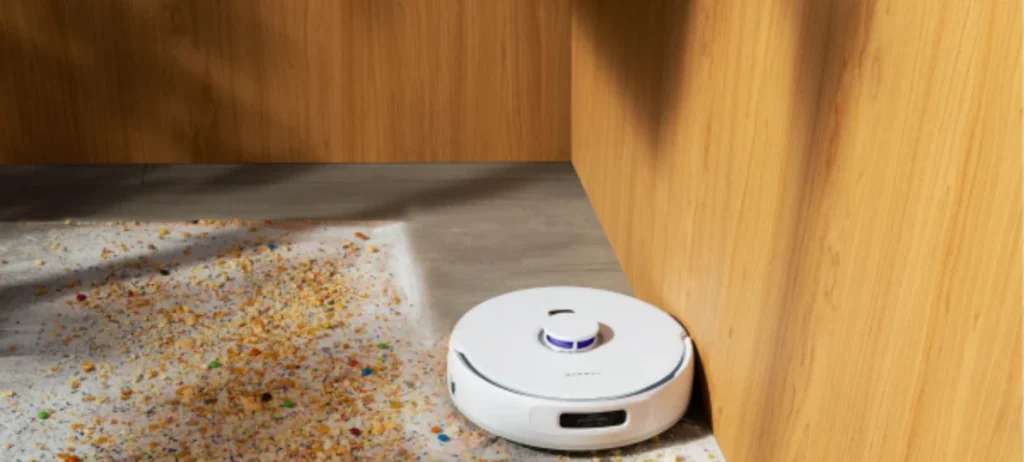
4️⃣ Are Robot Vacuums Enough on Their Own?
This depends on your home.
Robot Vacuum Alone Is Enough If:
- You have hard floors or low-pile carpet
- You run it daily
- You don’t have extreme shedding pets
- You want maintenance cleaning
You Still Need a Traditional Vacuum If:
- You have thick carpet
- You do seasonal deep cleans
- You clean stairs often
- You want maximum suction for occasional heavy messes
Many homeowners in 2026 use a hybrid approach:
- Robot vacuum for daily cleaning
- Upright for monthly deep cleaning
5️⃣ Pet Owners: Which Is Better?
If you have dogs or cats:
Robot vacuums are excellent for daily fur control, especially models with:
- Rubber brush rollers
- Tangle-resistant design
- High suction (6,000+ Pa)
- Self-empty station
But for deep embedded pet hair in carpet, a traditional vacuum still wins occasionally.
If pet hair is your biggest concern, see our guide on the Best Robot Vacuums for Pet Hair in 2026.
6️⃣ Smart Technology: A Major Advantage
Robot vacuums now include:
- LiDAR mapping
- Room-by-room cleaning
- No-go zones
- AI obstacle avoidance
- Auto mop lifting
- Self-washing mop pads (premium models)
Traditional vacuums offer none of this.
If you value smart home integration, robot vacuums are far ahead.
7️⃣ Noise Levels
- Traditional vacuum: 70–85 dB
- Robot vacuum: 55–70 dB
Robot vacuums are typically quieter and can run overnight.
Final Verdict: Which Is Better in 2026?
Choose a Robot Vacuum If:
✔ You value convenience
✔ You want daily automatic cleaning
✔ You have mostly hard floors
✔ You’re busy
✔ You dislike vacuuming
Choose a Traditional Vacuum If:
✔ You want maximum suction power
✔ You deep clean occasionally
✔ You have thick carpet throughout
✔ You’re on a tight budget
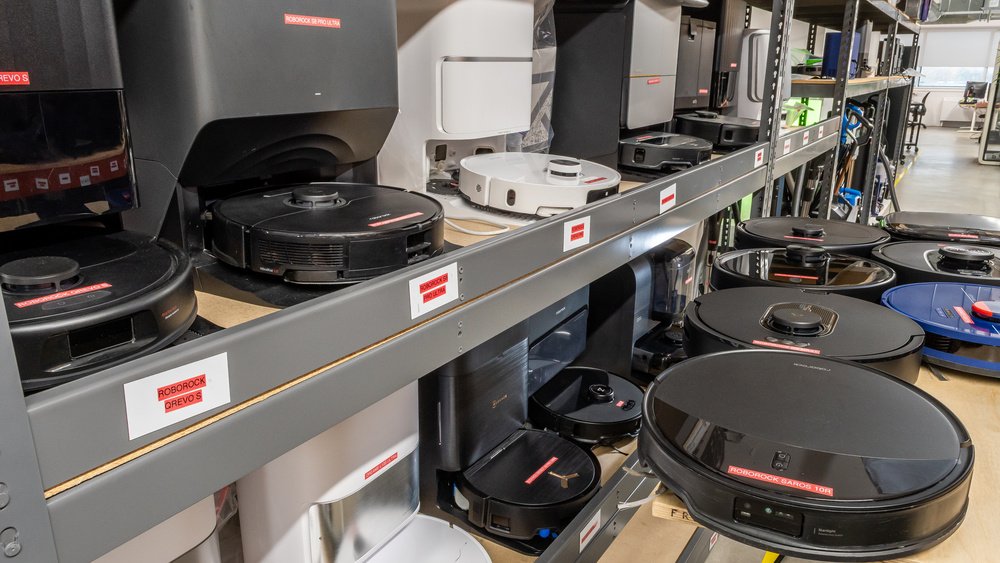
The Smartest Option for Most Homes in 2026
For most modern households:
👉 A robot vacuum for daily cleaning + a basic upright for occasional deep cleaning is the ideal setup.
If you’re ready to see the best-performing models this year, check out:
Top 5 Best Robot Vacuums of 2026
It breaks down:
- Best overall
- Best for pets
- Best for carpet
- Best budget option
- Best self-empty model